


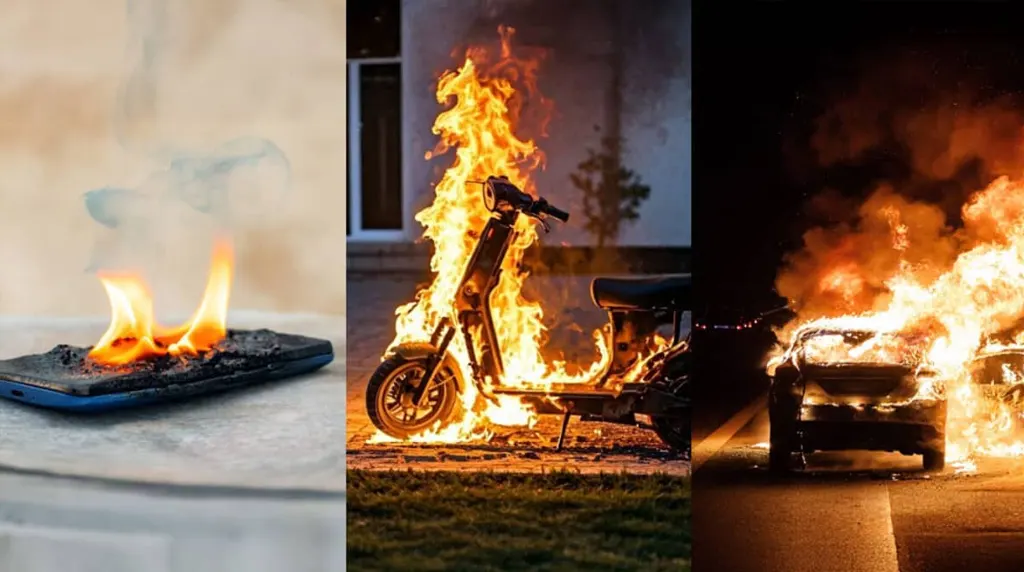
Battery fires are often described as being “extinguished,” only to reignite minutes or even hours later. This behavior surprises many people and is one of the most dangerous characteristics of modern battery-related fires.
Understanding why battery fires reignite — and how to reduce that risk — is essential for anyone using battery-powered devices in homes, vehicles, or workplaces.
Why Battery Fires Behave Differently
Most traditional fires require three elements:
- Fuel
- Oxygen
- Heat
Remove one of these, and combustion usually stops.
Battery fires, particularly those involving lithium-ion cells, behave differently because the fuel, oxygen source, and heat can all be contained within the battery itself.
This internal chemistry is the core reason re-ignition occurs.
The Role of Thermal Runaway
What Is Thermal Runaway?
Thermal runaway is a chain reaction inside a battery where:
- Rising temperature damages internal separators
- Short circuits form between electrodes
- More heat is generated
- Adjacent cells are affected
Once thermal runaway begins, it can continue even if external flames appear suppressed.
Why Flames Can Return
When a battery fire is temporarily suppressed:
- External flames may be reduced
- Surface combustion may stop
- Internal cell temperatures can remain critically high
If heat is not sufficiently reduced, remaining cells may:
- Vent flammable gases
- Ignite again once conditions allow
- Trigger additional runaway events
This leads to delayed re-ignition, sometimes repeatedly.
Common Causes of Re-Ignition
1. Residual Heat Inside Battery Cells
Battery casings can trap heat.
Even when flames disappear, internal temperatures may remain high enough to restart combustion.
2. Multiple Cells, One Failure at a Time
Many batteries contain:
- Several individual cells
- Closely packed together
One cell may fail first, while others:
- Are already overheating
- Ignite later as heat transfers
This staged failure pattern explains why fires can appear “under control” and then return.
3. Oxygen Generation Within the Battery
Certain battery chemistries release oxygen during decomposition.
This means:
- Smothering techniques may be limited
- Oxygen displacement alone may not stop the reaction
4. Incomplete Cooling
Some fire suppression methods focus on:
- Interrupting flames
- Displacing oxygen
But without sufficient cooling, thermal energy remains, increasing re-ignition risk.
Why Re-Ignition Is Especially Dangerous Indoors
Re-ignition is most hazardous in:
- Homes
- Vehicles
- Garages
- Storage rooms
Because:
- Fires may restart when people assume the danger has passed
- Smoke and gases may accumulate unnoticed
- Secondary ignition may occur without immediate response
This makes early-stage control and monitoring critical.
How to Reduce the Risk of Re-Ignition
1. Act Early
Smaller fires are:
- Easier to control
- Less likely to propagate between cells
- Less likely to generate extreme internal heat
Early intervention is one of the most effective risk reducers.
2. Focus on Heat Reduction, Not Just Flames
Suppressing visible flames is only part of the solution.
Reducing re-ignition risk often requires:
- Lowering internal temperatures
- Slowing heat transfer between cells
- Preventing further thermal escalation
3. Avoid Moving the Device Immediately
After suppression:
- Batteries may still be unstable
- Movement can introduce oxygen
- Damaged cells may vent again
If safe to do so, allow time for the device to cool and monitor it closely.
4. Isolate When Possible
If conditions allow:
- Move the device away from combustible materials
- Place it on a non-flammable surface
- Increase ventilation
Isolation reduces the impact if re-ignition occurs.
5. Use Layered Fire Safety Tools
No single tool eliminates all risk.
A layered approach may include:
- Certified fire extinguishers for larger incidents
- Fire blankets for surface containment
- Compact fire suppressants designed for early-stage response
Each addresses different aspects of the risk.
What This Means for Modern Fire Safety Planning
As battery-powered devices become more common, fire safety planning must adapt to:
- Higher energy density
- Faster failure modes
- Increased re-ignition potential
This does not mean existing fire safety tools are obsolete — but it does mean understanding their limitations is essential.
Final Thoughts
Battery fire re-ignition is not a failure of response — it is a characteristic of the technology itself.
Reducing risk depends on:
- Early intervention
- Managing heat, not just flames
- Using appropriate tools
- Maintaining realistic expectations
Awareness is the first step toward safer outcomes in battery-powered environments.
About ZUFF
ZUFF develops compact fire suppression solutions designed to help address small, early-stage fires associated with modern devices.
ZUFF products are intended to complement existing fire safety equipment, not replace certified extinguishers or emergency services.